
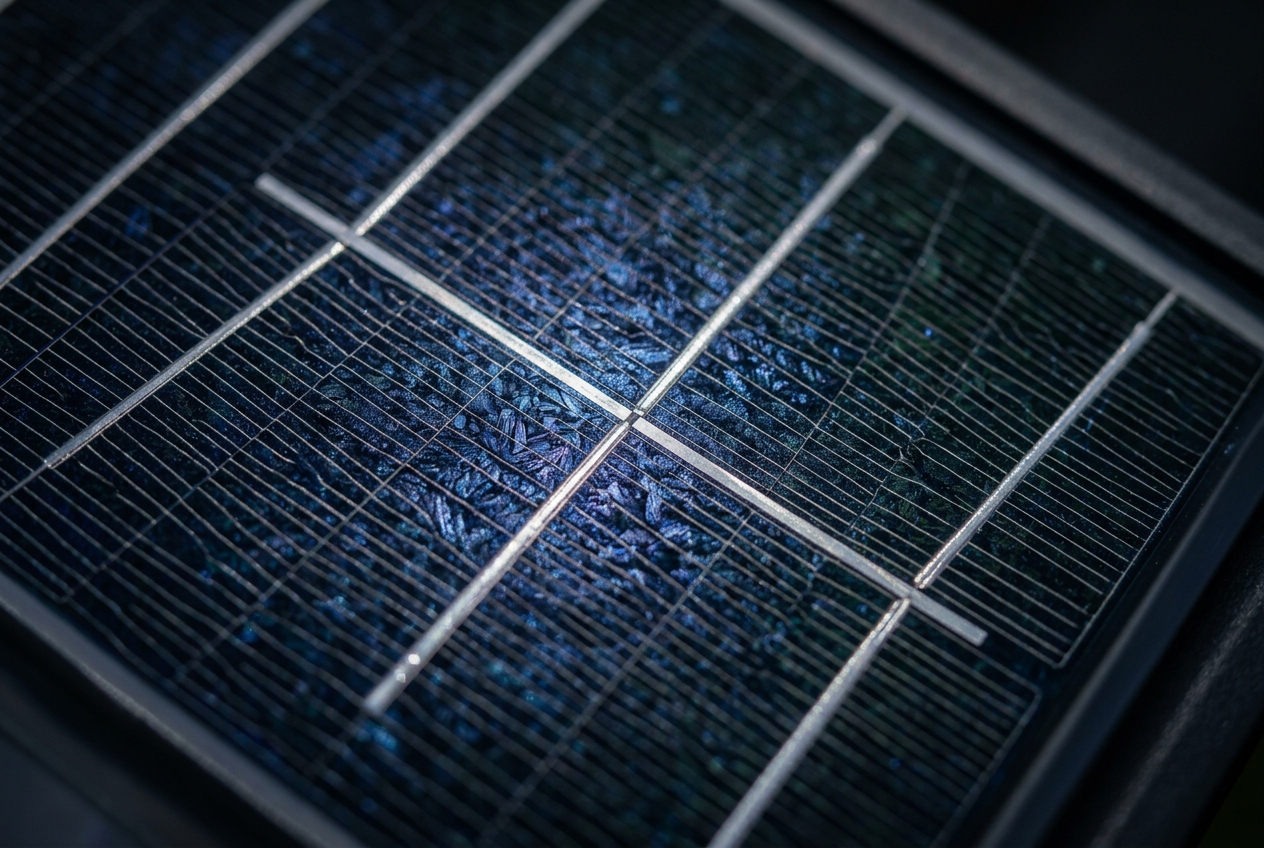
N-Type TOPCon vs Mono PERC in Kerala: Generation Efficiency, Monsoon Performance & Heat Degradation
Detailed engineering comparison between N-Type TOPCon and P-Type Mono PERC solar panels. Performance in Kerala high ambient heat, low-light monsoon conditions, temperature coefficients, and 30-year degradation rates.
Disclaimer: GSR Energies is an independent solar EPC contractor empaneled for PM Surya Ghar & KSEB net-metering installations. Government policies and subsidy guidelines are referenced directly from MNRE/KSEB official notifications.
- N-Type TOPCon (Tunnel Oxide Passivated Contact) has replaced P-Type Mono PERC as the state-of-the-art standard for rooftop solar.
- TOPCon offers module efficiency of 22.0% – 22.8%, compared to 20.5% – 21.3% for standard Mono PERC.
- Superior temperature coefficient of -0.30%/°C ensures significantly lower generation loss during blistering Kerala summer afternoons (35°C–38°C ambient).
- Zero Light Induced Degradation (LID) in N-Type silicon ensures 1% to 2% higher generation right from year one.
- First-year degradation of TOPCon is capped at 1.0% (vs 2.0% for Mono PERC), with an annual degradation of only 0.40% over 30 years.
Table of Contents
Silicon Physics: Why N-Type TOPCon Outperforms P-Type Mono PERC
For over a decade, P-Type Mono PERC was the industry workhorse. However, P-Type silicon uses boron doping. When exposed to sunlight and oxygen, boron forms boron-oxygen complexes that cause Light Induced Degradation (LID), dropping module performance by 1.5% to 2.5% in the initial months.
N-Type TOPCon uses phosphorus doping instead of boron. Because there is no boron, LID is eliminated. Furthermore, an ultra-thin tunnel oxide layer combined with passivated poly-silicon contacts minimizes surface recombination losses, allowing electrons to flow freely and boosting cell conversion efficiency above 25%.
Thermal Coefficient: Kerala Summer Heat Reality
A solar panel rated at 550W produces 550W only at Standard Test Conditions (STC) of 25°C cell temperature. On a typical Kerala summer afternoon when ambient air hits 36°C, rooftop solar panels heat up to 60°C – 65°C.
For every degree above 25°C, solar panels lose power based on their Temperature Coefficient of Pmax. Mono PERC loses ~0.35% per degree, whereas N-Type TOPCon loses only ~0.30% per degree. Over a 40°C thermal delta, TOPCon retains approximately 2.5% to 3.0% more peak power output at peak heat hours.
Monsoon Low-Light & Diffuse Light Performance
Kerala experiences heavy southwest and northeast monsoons spanning June to November. During overcast days, solar irradiance drops from 1000 W/m² to 150 – 300 W/m².
N-Type TOPCon cells have superior spectral response in the shorter blue and infrared wavelengths that penetrate cloud cover. Independent tests show TOPCon modules generate 4% to 7% more daily units than legacy Mono PERC under diffuse monsoon conditions.
| Technical Parameter | P-Type Mono PERC | N-Type TOPCon (GSR Standard) |
|---|---|---|
| Cell Substrate Type | P-Type Silicon (Boron Doped) | N-Type Silicon (Phosphorus Doped) |
| Module Efficiency | 20.5% – 21.2% | 22.0% – 22.8% |
| Temperature Coefficient (Pmax) | -0.35% / °C | -0.30% / °C (Lower heat loss) |
| First-Year Degradation | 2.0% – 2.5% | 1.0% Max |
| Annual Linear Degradation | 0.55% / year | 0.40% / year |
| 30-Year Retained Power | ~84.8% | 87.4% – 89.0% |
| Bifaciality Factor (if bifacial) | 70% ± 5% | 80% ± 5% |
| Performance Warranty | 25 Years | 30 Years Linear Warranty |
Kerala Rooftop Solar & KSEB Implementation Impact
How these regulations, technical specifications, and standards apply specifically to homes and commercial setups connected to the Kerala State Electricity Board (KSEBL) grid:
- Requires up to 10% to 12% less rooftop area for the same kilowatt capacity—crucial for Kerala residential roofs with water tanks or chimneys.
- Generates 6% to 8% more usable kilowatt-hours during monsoon cloudy days due to enhanced low-light response in diffuse irradiance.
- Backed by an extended 30-year linear performance warranty rather than standard 25-year limits.
Frequently Asked Questions
Is TOPCon significantly more expensive than Mono PERC in 2026?
No. Global manufacturing scale has brought TOPCon pricing almost to parity with Mono PERC, while providing 5% to 8% greater total lifetime electricity generation.
Does GSR Energies use TOPCon panels for PM Surya Ghar residential projects?
Yes. GSR Energies installs Tier-1 DCR-compliant N-Type TOPCon modules with 30-year performance warranties for all residential and commercial projects.
Internal Solar Resources for Kerala
Explore Helpful Kerala Solar Tools & Guides
Kerala Solar Subsidy Calculator
Calculate system sizing, monthly savings & PM Surya Ghar subsidy
KSEB Net Metering Regulations
Full step-by-step application walkthrough for KSEBL bi-directional meters
Residential Rooftop Solar Solutions
On-grid, hybrid, and battery storage turnkey installation packages
Free Kerala Rooftop Site Assessment
Request shadow analysis & personalized engineering feasibility study
Free Solar Proposal For Your Roof
Planning Solar for Your Home or Business in Kerala?
Get an accurate rooftop survey, shadow analysis, and subsidy calculation — with zero charges and zero obligation.
Related Solar Guides & News

Central Schemes & Subsidies
PM Surya Ghar Muft Bijli Yojana in Kerala: 2026 Subsidy Structure, KSEB Feasibility & Application Guide
Read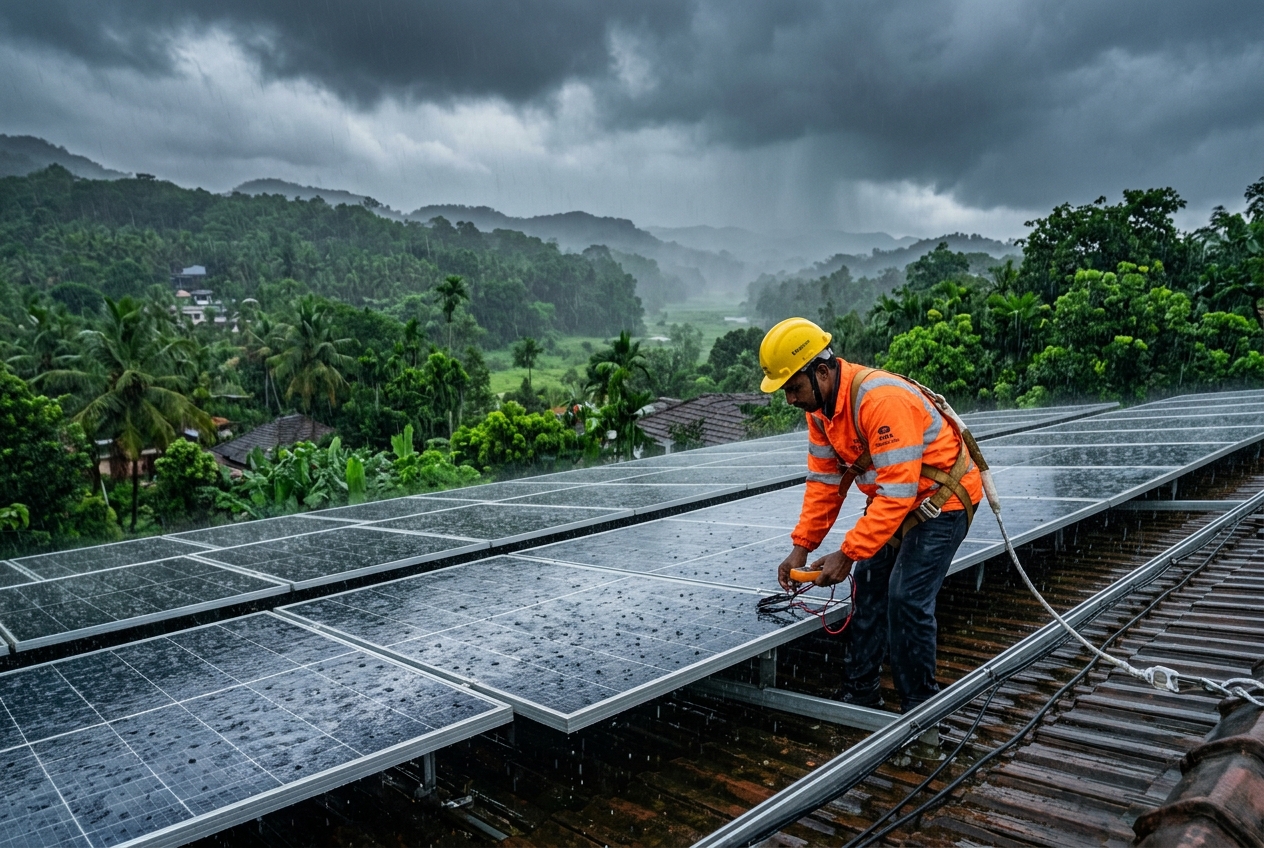
Maintenance & Performance
Kerala Monsoon Solar Maintenance: Plant Generation in Heavy Rain, Algae Prevention & Lightning Protection
Read
Sizing, Savings & ROI