

How to Size a Rooftop Solar System for Kerala Homes: 1kW, 2kW, 3kW, 5kW & 10kW Guide
Step-by-step engineering guide to calculating exact rooftop solar capacity for your home in Kerala. Sizing formulas, shadow-free roof area requirements, seasonal monsoon margins, and contract demand limits.
Disclaimer: GSR Energies is an independent solar EPC contractor empaneled for PM Surya Ghar & KSEB net-metering installations. Government policies and subsidy guidelines are referenced directly from MNRE/KSEB official notifications. Regulations, tariffs, fees and application procedures may change; confirm the latest official KSEB/KSERC/MNRE information before making a final investment decision.
- Rule of Thumb in Kerala: 1 kW of rooftop solar produces an annual average of 3.8 to 4.2 units (kWh) per day.
- Sizing is calculated by dividing your average monthly electricity units by 120 (30 days × 4 units/kW).
- Space requirement: 80 to 100 square feet of shadow-free rooftop space is required per 1 kW installed.
- Sanctioned connected load limits: Your solar inverter capacity cannot exceed your KSEB sanctioned load without an upgrade.
- Over-sizing vs Under-sizing: Sizing to cover 90%–100% of annual demand maximizes financial returns under net metering rules.
Table of Contents
The Core Solar Sizing Formula for Kerala Homes
To determine the optimal solar plant capacity, review your last three KSEB electricity bills to calculate your average bi-monthly unit consumption.
Step 1: Divide your bi-monthly units by 2 to determine monthly consumption (e.g., 600 bi-monthly units = 300 units/month).
Step 2: Divide monthly units by 30 days to get daily consumption (300 ÷ 30 = 10 units/day).
Step 3: In Kerala, 1 kW of solar generates approximately 4.0 units per day on an annualized basis. Divide daily units by 4.0 (10 ÷ 4.0 = 2.5 kW). In this example, a 3 kW system represents the ideal engineering choice.
Capacity Breakdown: Sizing Matrix from 1 kW to 10 kW
Below is a breakdown of system capacities, estimated daily production, required roof area, and applicable central subsidy under PM Surya Ghar.
| Capacity | Shadow-Free Roof Area | Avg. Daily Units | Typical Bi-Monthly Bill Offset | PM Surya Ghar Subsidy |
|---|---|---|---|---|
| 1 kW | 80 – 100 sq.ft | 3.8 – 4.2 Units | Bills up to ₹1,500 (150–200 units) | ₹30,000 flat DBT |
| 2 kW | 160 – 200 sq.ft | 7.6 – 8.4 Units | Bills ₹1,500 – ₹3,000 (300–400 units) | ₹60,000 flat DBT |
| 3 kW (Optimal) | 240 – 300 sq.ft | 11.4 – 12.6 Units | Bills ₹3,000 – ₹5,500 (500–600 units) | ₹78,000 (Max Cap) |
| 5 kW | 400 – 500 sq.ft | 19.0 – 21.0 Units | Bills ₹6,000 – ₹12,000 (800–1,000 units) | ₹78,000 flat cap |
| 6 kW | 480 – 600 sq.ft | 22.8 – 25.2 Units | Bills ₹12,000 – ₹18,000 (1,100–1,300 units) | ₹78,000 flat cap |
| 10 kW | 800 – 1,000 sq.ft | 38.0 – 42.0 Units | Bills ₹20,000+ (1,800–2,200 units) | ₹78,000 flat cap |
What Household Appliances Can Run on Each Capacity?
Because grid-connected on-grid solar systems synchronize seamlessly with the utility grid, the solar plant does not impose appliance "start-up surge" limitations.
A 3 kW on-grid plant easily handles daytime operation of one 1.5-ton inverter air conditioner, refrigerator, washing machine, television, fans, and LED lighting, with surplus power exported to KSEB.
A 5 kW to 6 kW plant supports 2 to 3 air conditioners operating simultaneously alongside induction cooktops, water pumps, and domestic EV two-wheeler or four-wheeler charging.
Roof Space, Orientation, Shading & Structural Suitability
True South orientation at 10° to 12° tilt provides the highest annual yield in Kerala. If your roof faces East or West, annual generation reduces by approximately 10% to 15%, which can be compensated by adding one additional high-wattage module.
Shading from parapet walls, overhead water storage tanks, and neighboring trees must be analyzed using sun-path diagrams during the physical site survey to ensure string bypass diodes are not permanently triggered.
Kerala Rooftop Solar & KSEB Implementation Impact
How these regulations, technical specifications, and standards apply specifically to homes and commercial setups connected to the Kerala State Electricity Board (KSEBL) grid:
- Prevents Kerala homeowners from over-investing in unnecessary capacity or under-sizing and remaining stuck in high KSEB tariff slabs.
- Ensures accurate spatial planning for sloped tiled roofs and flat concrete terraces with overhead water tanks.
- Incorporates seasonal monsoon variation into annual energy balance calculations.
Frequently Asked Questions
Can I install 5 kW of solar if my KSEB connected load is only 3 kW?
Not immediately. You must first apply to KSEB for a Connected Load Enhancement from 3 kW to 5 kW. GSR Energies assists homeowners with the digital load enhancement paperwork through the KSEB portal.
Can solar panels be installed on a sloped tiled roof in Kerala?
Yes. GSR Energies designs custom elevated truss structures fabricated from hot-dip galvanized steel or aluminum rails that mount securely above roof tiles without cracking or puncturing the waterproof surface.
Internal Solar Resources for Kerala
Explore Helpful Kerala Solar Tools & Solutions
Solar Savings Calculator
Calculate system sizing, monthly units & PM Surya Ghar subsidy
Residential Rooftop Solar
Home solar systems (3kW – 10kW) with KSEB net metering
Commercial & Industrial Solar
Turnkey rooftop & captive solar for businesses, hospitals & factories
Verified Kerala Projects
100+ executed rooftop installations across Kerala districts
Free Site Assessment
Request shadow survey & personalized engineering feasibility
Free Solar Proposal For Your Roof
Planning Solar for Your Home or Business in Kerala?
Get an accurate rooftop survey, shadow analysis, and subsidy calculation — with zero charges and zero obligation.
Related Solar Guides & News
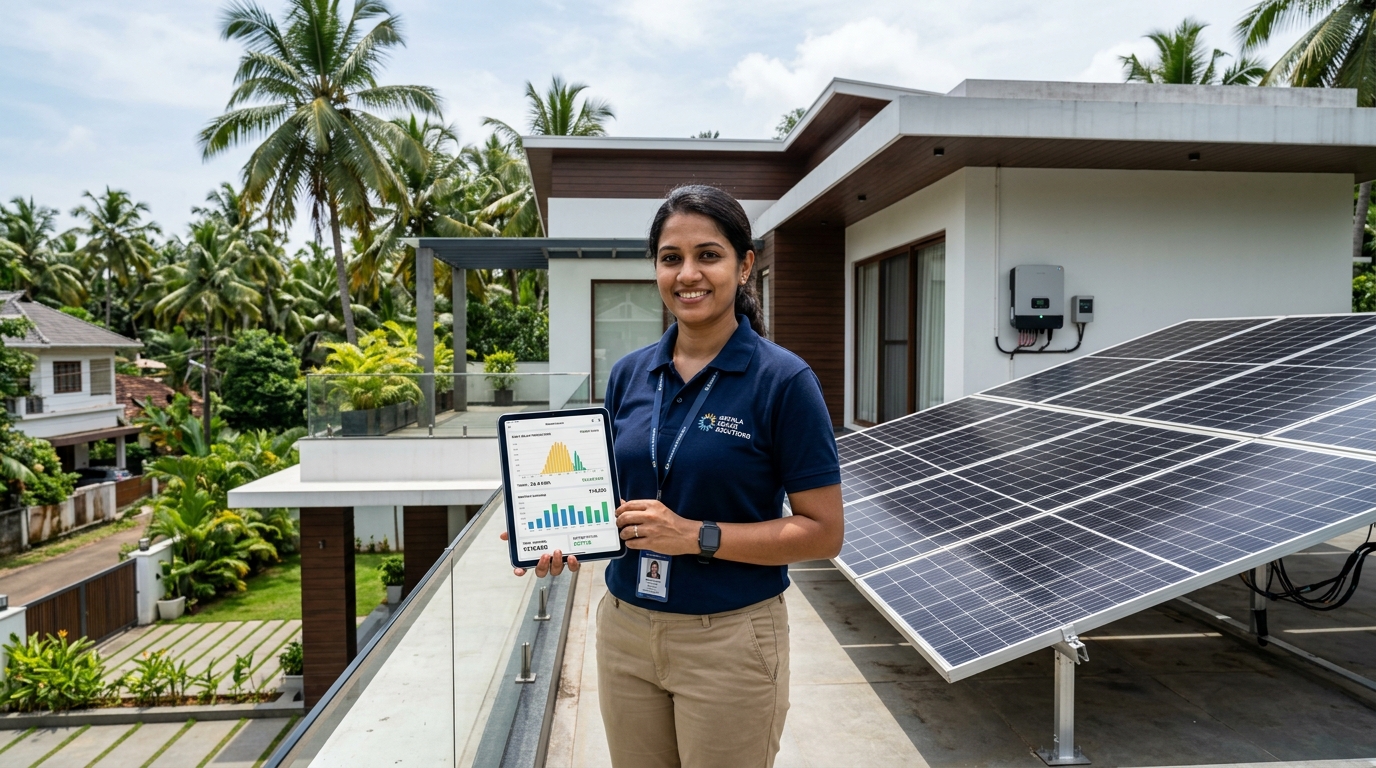
Sizing, Savings & ROI
Solar System Sizing & Payback Period in Kerala: Slabs, Peak Sun Hours & 25-Year Compounding Returns
Read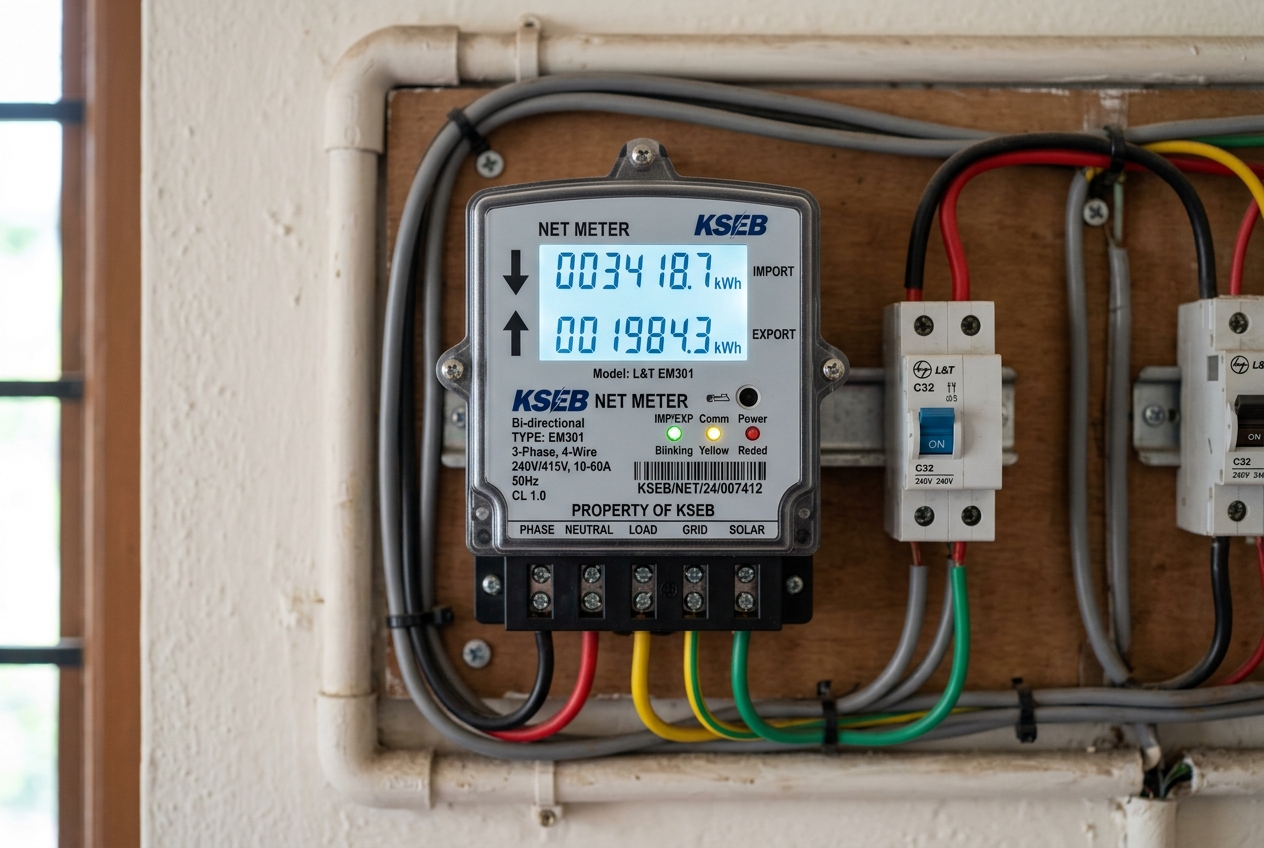
KSEB & Kerala Regulations
KSEB Solar Net Metering Explained: Bi-Directional Billing, Banking Rules & KSERC Tariff Settlement
Read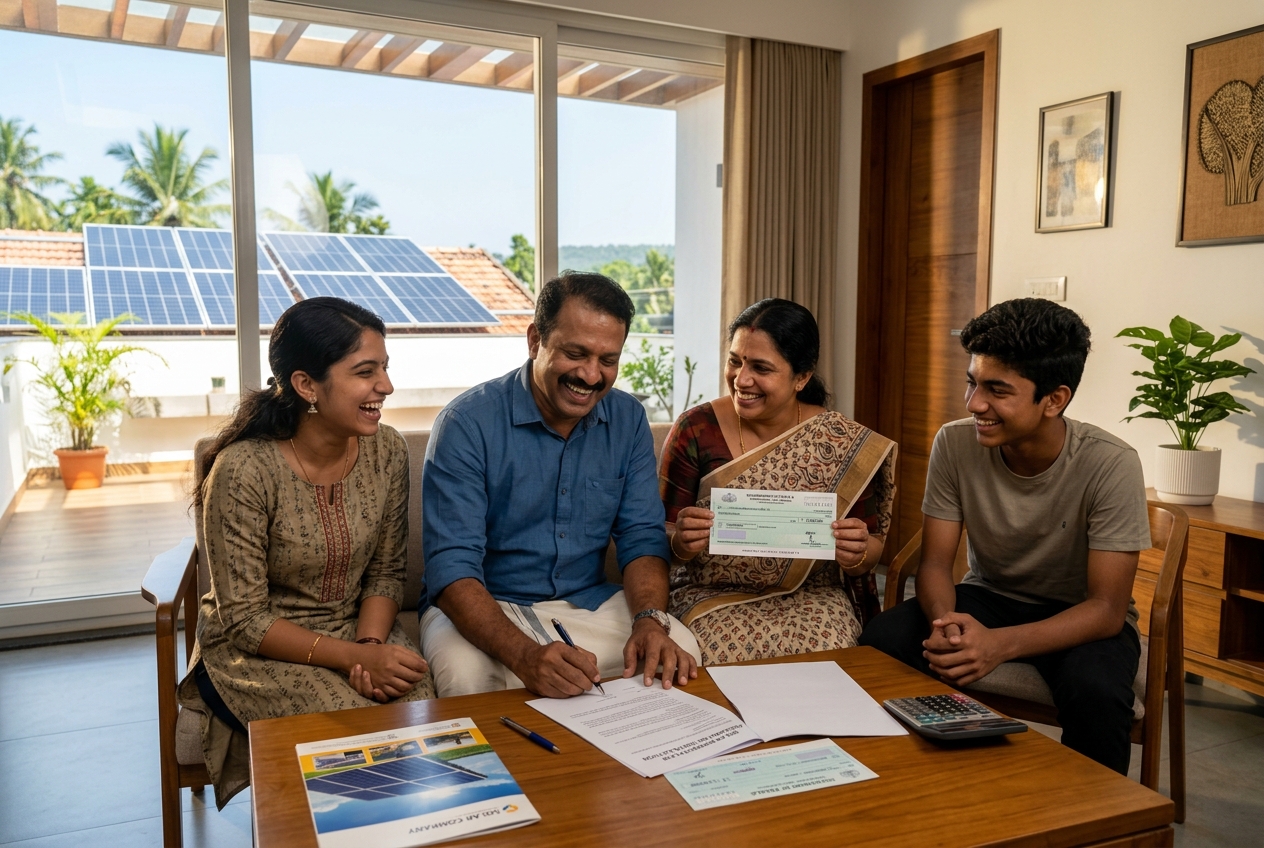
Central Schemes & Subsidies