
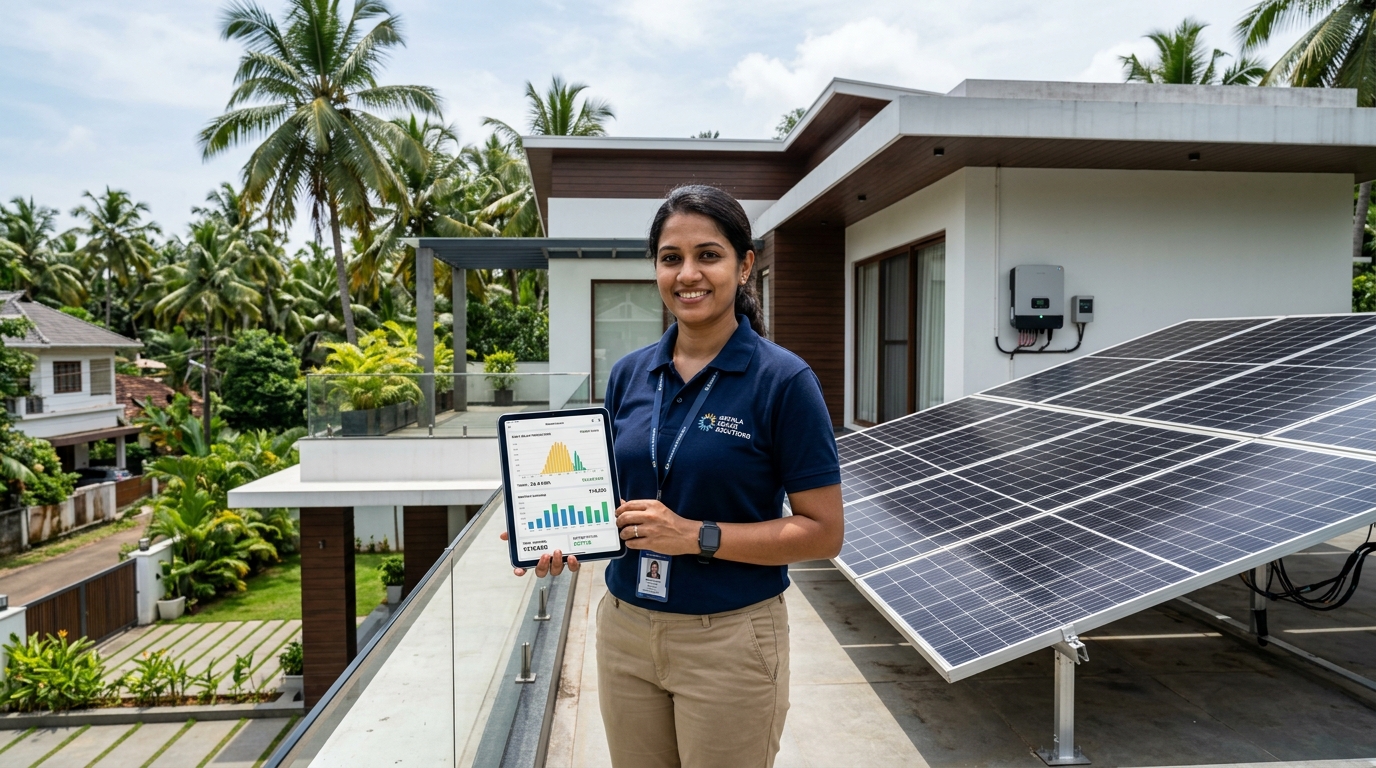
Solar System Sizing & Payback Period in Kerala: Slabs, Peak Sun Hours & 25-Year Compounding Returns
How to accurately size your rooftop solar plant based on bi-monthly KSEB electricity bills. Realistic payback calculations, Kerala peak sun hours (4.2–4.8), and financial modeling of 25-year compounding returns.
Disclaimer: GSR Energies is an independent solar EPC contractor empaneled for PM Surya Ghar & KSEB net-metering installations. Government policies and subsidy guidelines are referenced directly from MNRE/KSEB official notifications.
- In Kerala, 1 kW of well-engineered rooftop solar produces an average of 4.0 to 4.5 units (kWh) of clean electricity per day (1,400 to 1,550 units annually).
- To calculate required system kW: Divide your bi-monthly KSEB electricity bill units by 240 (units per kW per 2 months).
- A typical 3 kW residential plant in Kerala generates ~360 units per month, saving ~₹2,800 to ₹3,500 every month on electricity bills.
- With the ₹78,000 PM Surya Ghar subsidy, the net out-of-pocket investment drops to approximately ₹1,00,000 – ₹1,25,000.
- Payback period in Kerala is between 3.2 and 4.2 years, after which you receive 21+ years of completely free electricity.
Table of Contents
Accurate Sizing Formula for Kerala Households
Many consumers incorrectly size their solar plants based on house square footage or roof size. Sizing should always be driven by electrical energy consumption (units / kWh) recorded on your bi-monthly KSEB bill.
Formula: Desired System kW = (Bi-Monthly Units on KSEB Bill ÷ 60 days) ÷ 4.2 peak sun hours.
| Bi-Monthly KSEB Bill | Bi-Monthly Consumption | Recommended Solar Capacity | Roof Area Required |
|---|---|---|---|
| ₹1,500 – ₹2,500 | 200 – 320 units | 1.5 kW to 2 kW | 120 – 160 sq.ft |
| ₹3,000 – ₹5,000 | 400 – 600 units | 3 kW (Optimal with ₹78k subsidy) | 240 – 260 sq.ft |
| ₹6,000 – ₹9,000 | 700 – 1,000 units | 4 kW to 5 kW | 320 – 400 sq.ft |
| ₹10,000 – ₹18,000 | 1,200 – 2,000 units | 6 kW to 8 kW | 480 – 640 sq.ft |
| ₹20,000 – ₹35,000 | 2,500 – 4,000 units | 10 kW to 15 kW (3-Phase) | 800 – 1,200 sq.ft |
Solar Insolation Reality in Kerala
According to NASA Surface Meteorology and National Institute of Solar Energy (NISE) solar radiation maps, Kerala receives an annual average global horizontal irradiance (GHI) of 5.1 to 5.6 kWh/m²/day.
Factoring in atmospheric moisture, monsoon cloud attenuation, and standard system derating factors (inverter losses, soiling, cable resistance), an engineered solar plant in Kerala reliably produces 4.0 to 4.5 units per installed kilowatt per day on an annual aggregate basis.
Realistic Financial Payback: 3 kW Case Study
Let us review the audited numbers for a standard 3 kW Monocrystalline / TOPCon installation in Malappuram or Calicut:
Gross Turnkey Cost: ~₹1,90,000 to ₹2,05,000 (including panels, On-Grid inverter, MS/GI structure, ACDB/DCDB, dual earthing, lightning arrestor, net meter documentation, and KSEB energization).
Less Central Subsidy (PM Surya Ghar DBT): -₹78,000.
Net Customer Investment: ~₹1,12,000 to ₹1,27,000.
Average Annual Generation: 4,380 units. Valued at KSEB average tariff (~₹8.00 per unit under high slabs) = ~₹35,000 savings per year.
Simple Payback Period: ₹1,20,000 ÷ ₹35,000 = 3.4 Years.
Kerala Rooftop Solar & KSEB Implementation Impact
How these regulations, technical specifications, and standards apply specifically to homes and commercial setups connected to the Kerala State Electricity Board (KSEBL) grid:
- Shields Kerala families against inevitable future KSERC electricity tariff hikes (historically 3% to 5% compounded annually).
- Delivers an annualized tax-free return on investment (ROI) exceeding 24% to 28% per annum, beating mutual funds and fixed deposits.
- Significantly increases the resale and rental valuation of the residential property.
Frequently Asked Questions
What happens if I generate more electricity than I consume in a month?
The excess units are automatically credited to your KSEB banking balance. You can consume these units during subsequent months (e.g. monsoons) at zero cost.
Does rooftop solar reduce electricity bills to zero?
Your energy charge becomes ₹0. You only pay the mandatory fixed meter rent and electricity duty (typically ₹60 to ₹120 bi-monthly for residential connections).
Internal Solar Resources for Kerala
Explore Helpful Kerala Solar Tools & Guides
Kerala Solar Subsidy Calculator
Calculate system sizing, monthly savings & PM Surya Ghar subsidy
KSEB Net Metering Regulations
Full step-by-step application walkthrough for KSEBL bi-directional meters
Residential Rooftop Solar Solutions
On-grid, hybrid, and battery storage turnkey installation packages
Free Kerala Rooftop Site Assessment
Request shadow analysis & personalized engineering feasibility study
Free Solar Proposal For Your Roof
Planning Solar for Your Home or Business in Kerala?
Get an accurate rooftop survey, shadow analysis, and subsidy calculation — with zero charges and zero obligation.
Related Solar Guides & News

Central Schemes & Subsidies
PM Surya Ghar Muft Bijli Yojana in Kerala: 2026 Subsidy Structure, KSEB Feasibility & Application Guide
Read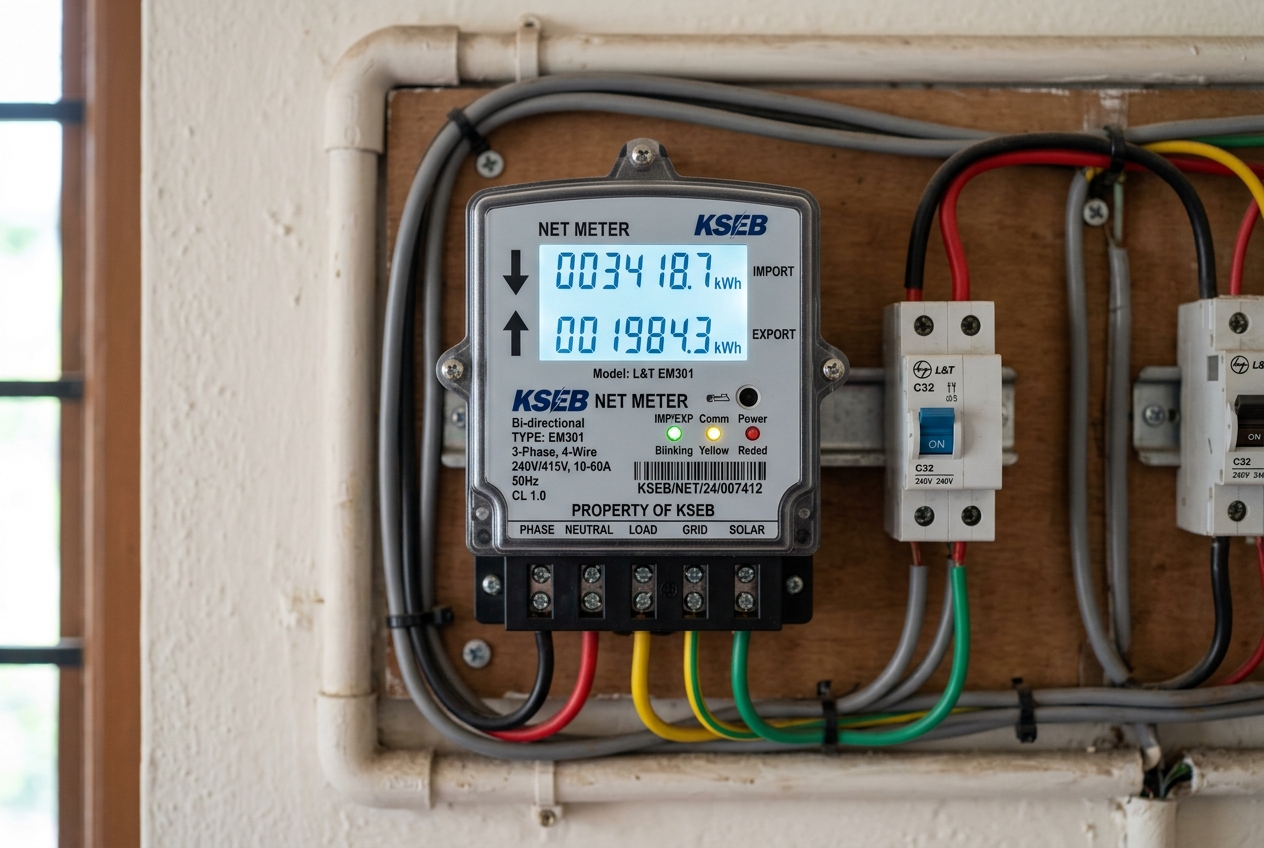
KSEB & Kerala Regulations
KSEB Solar Net Metering Explained: Bi-Directional Billing, Banking Rules & KSERC Tariff Settlement
Read
Solar Technology & Hardware