
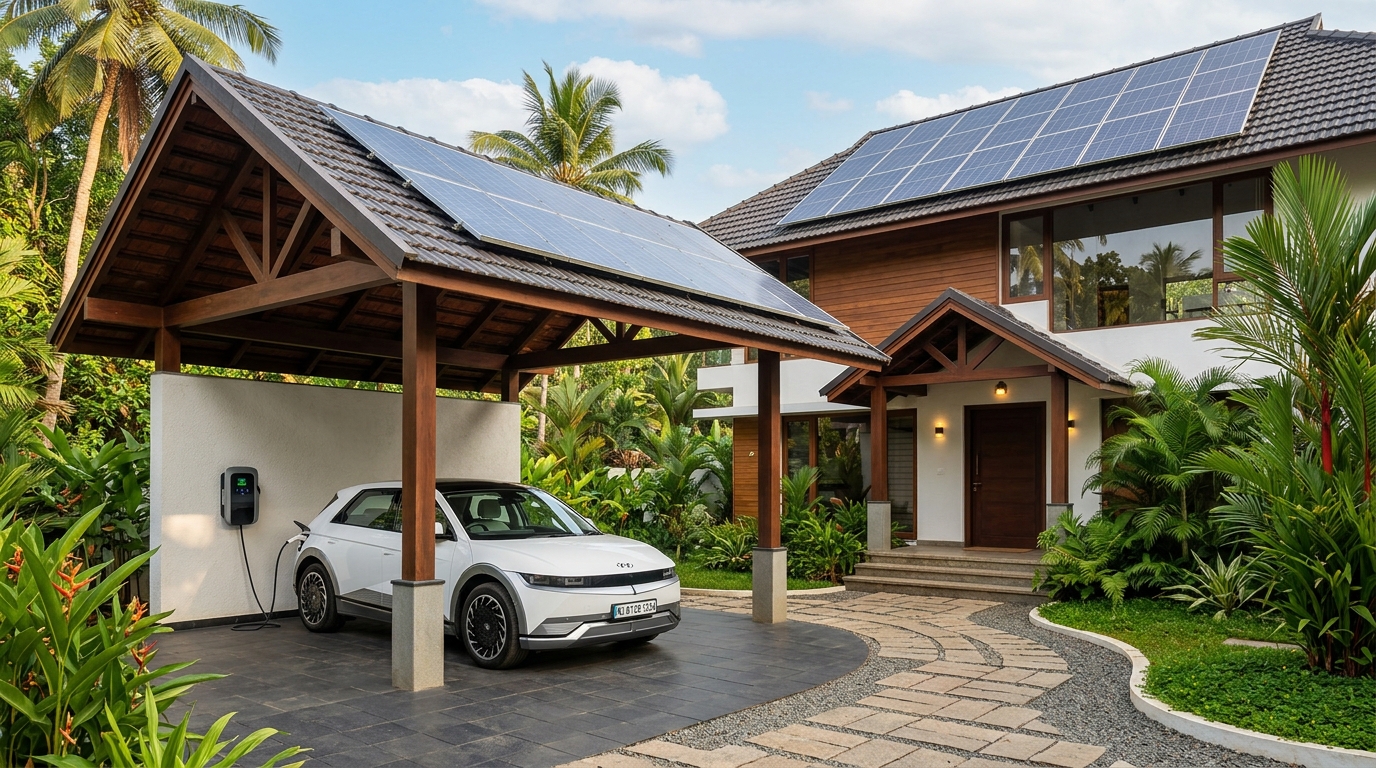
EV Charging with Rooftop Solar in Kerala: How Home Solar Cuts Electric Car Running Costs to ₹0.35/km
How Kerala electric car owners can pair 3 kW to 5 kW rooftop solar with home EV chargers (Tata Nexon EV, Punch EV, MG ZS, Tiago EV) to drive 1,500 km per month completely free while bypassing KSEB high-tier tariffs.
Disclaimer: GSR Energies is an independent solar EPC contractor empaneled for PM Surya Ghar & KSEB net-metering installations. Government policies and subsidy guidelines are referenced directly from MNRE/KSEB official notifications.
- Pairing rooftop solar with an electric vehicle slashes driving fuel costs from ₹8.50/km (petrol) to approximately ₹0.35/km with amortized solar generation.
- A 3 kW to 5 kW rooftop solar plant in Kerala generates 12 to 22 units daily—ample to replenish a 40–60 km daily commute with surplus remaining for household air conditioning.
- KSEB bi-directional net metering acts as a free virtual battery: export solar power to the grid during bright daylight, and draw it back overnight to charge your EV at zero net energy cost.
- Home Level-2 AC wallbox chargers (3.3 kW single-phase or 7.2 kW single/three-phase) seamlessly integrate with domestic solar plants without requiring expensive commercial HT connections.
- Combined payback period: A homeowner replacing petrol with solar-powered EV charging recovers their entire solar installation cost in just 2.5 to 3.5 years.
Table of Contents
The Financial Breakdown: Petrol vs Grid Charging vs Solar EV Charging
With petrol prices in Kerala hovering around ₹106 per liter, an average petrol car delivering 13–15 km/l incurs a running cost of ₹7.20 to ₹8.50 per kilometer. For an average Kerala driver commuting 1,200 km monthly, that amounts to over ₹9,500 every single month in fuel alone.
Charging an electric vehicle (such as a Tata Nexon EV, Punch EV, or MG Windsor) via standard KSEB grid power costs approximately ₹1.80 to ₹2.20 per km at domestic rates. But when powered by a rooftop solar system with the PM Surya Ghar subsidy, your marginal cost per unit drops to near zero once the capital cost is amortized over 25 years—yielding a true operating cost of just ₹0.35 per kilometer.
| Vehicle Type | Monthly Travel (1,200 km) | Energy / Fuel Cost per km | Annual Fuel Expense |
|---|---|---|---|
| Petrol Hatchback / Compact SUV | 85 – 95 Liters | ₹7.50 – ₹8.50 / km | ₹1,08,000 – ₹1,22,000 |
| EV on Regular KSEB Grid Power | 180 – 220 Units (kWh) | ₹1.80 – ₹2.20 / km | ₹26,000 – ₹31,000 |
| EV on Rooftop Solar (GSR Plant) | 180 – 220 Solar Units | ₹0.30 – ₹0.40 / km | ₹4,300 – ₹5,800 (Over 90% Savings) |
How to Size Your Rooftop Solar System for Both Home & EV
To ensure your solar system comfortably covers both household electricity needs (lights, refrigerator, inverter ACs, water pumps) and EV driving, calculate the combined energy budget.
A typical modern EV consumes roughly 14 to 16 kWh per 100 km of driving. If you travel 40 km daily, the car requires approximately 6 kWh (units) of electricity per day. Add a standard 4-bedroom home requirement of 10 to 12 units daily, and your total daily demand is 16 to 18 units.
In Kerala, a 4 kW to 5 kW rooftop solar plant produces 16 to 22 units per day on average, making a 4 kW or 5 kW system the optimal sweet spot for single-EV families.
Charging Logistics: Day Charging vs Nighttime Net Metering
Many EV owners wonder: "I work away from home during the day when the sun is shining. How does rooftop solar charge my car at night?"
This is where KSEB Bi-Directional Net Metering acts as a frictionless energy bank. During the daytime (8:30 AM to 5:00 PM), your solar panels generate peak power. Since the car is away, 80% to 90% of this solar electricity is exported into the KSEB grid, spinning your import-export meter backward and accumulating credit units on your KSEB consumer account.
When you return home in the evening, plug your car into your home AC wallbox charger overnight. The power drawn from the grid is offset 1-to-1 against the credits generated earlier that day. In your bi-monthly bill, you only pay the nominal fixed meter charge.
Charger Selection, Electrical Earthing & Surge Protection
Connecting an EV charger to a domestic solar installation requires dedicated electrical protection. A 7.2 kW single-phase AC charger pulls 32 Amperes continuously for 4 to 6 hours, which standard 16A domestic plug points cannot safely sustain.
Every GSR Energies solar-EV setup includes a dedicated sub-distribution board with Type-B RCD (Residual Current Device) for DC leakage protection, 40A miniature circuit breakers, Class-II AC Surge Protection Devices (SPD), and an independent low-resistance chemical earthing pit dedicated to the vehicle charger.
Kerala Rooftop Solar & KSEB Implementation Impact
How these regulations, technical specifications, and standards apply specifically to homes and commercial setups connected to the Kerala State Electricity Board (KSEBL) grid:
- Protects EV owners from jumping into higher KSEB domestic tariff slabs (>350 units bi-monthly at ₹7.80–₹9.00/unit).
- Eliminates dependency on highway DC public fast chargers (which charge ₹21 to ₹24 per unit plus GST).
- Contributes zero tailpipe emissions and zero grid coal generation footprint across Kerala cities.
Frequently Asked Questions
Do I need a 3-phase connection for solar EV charging in Kerala?
For 3.3 kW slow charging, a single-phase connection is sufficient. However, for 7.2 kW fast AC wallbox chargers or solar plants 4 kW and above, KSEB regulations recommend a 3-phase connection to balance phase loads and prevent voltage drops.
Can an EV battery be used to power the house during a blackout (V2H/V2L)?
Several modern EVs (such as the Ioniq 5, EV6, and Mahindra BE 6) support Vehicle-to-Load (V2L) capability up to 3.3 kW, enabling you to power critical household appliances directly from the car during grid outages.
Does charging an EV degrade my rooftop solar panels?
Not at all. Solar panels generate electricity based purely on irradiance. Whether the electricity is used by a refrigerator, an EV charger, or exported to KSEB has zero impact on the panels or solar inverter.
Internal Solar Resources for Kerala
Explore Helpful Kerala Solar Tools & Guides
Kerala Solar Subsidy Calculator
Calculate system sizing, monthly savings & PM Surya Ghar subsidy
KSEB Net Metering Regulations
Full step-by-step application walkthrough for KSEBL bi-directional meters
Residential Rooftop Solar Solutions
On-grid, hybrid, and battery storage turnkey installation packages
Free Kerala Rooftop Site Assessment
Request shadow analysis & personalized engineering feasibility study
Free Solar Proposal For Your Roof
Planning Solar for Your Home or Business in Kerala?
Get an accurate rooftop survey, shadow analysis, and subsidy calculation — with zero charges and zero obligation.
Related Solar Guides & News
Sizing, Savings & ROI
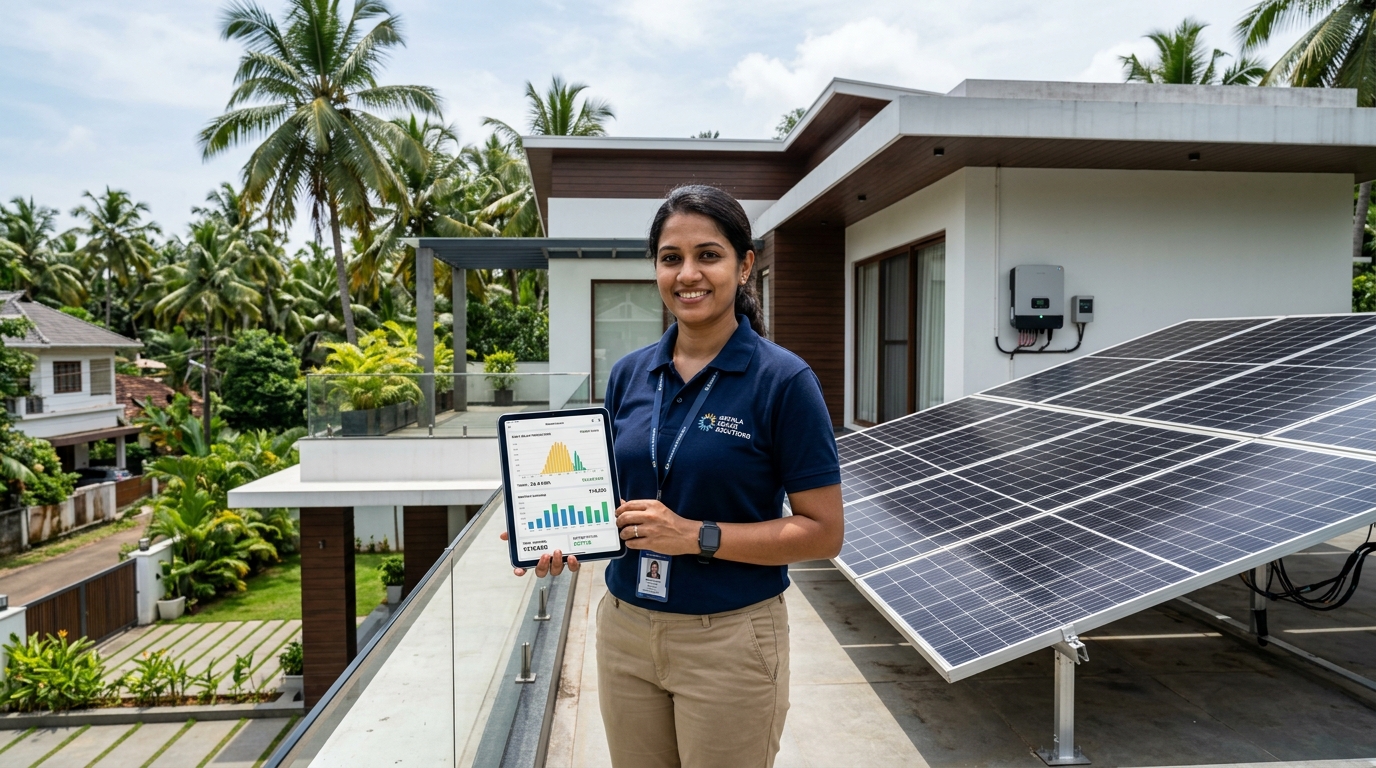
Solar System Sizing & Payback Period in Kerala: Slabs, Peak Sun Hours & 25-Year Compounding Returns
Read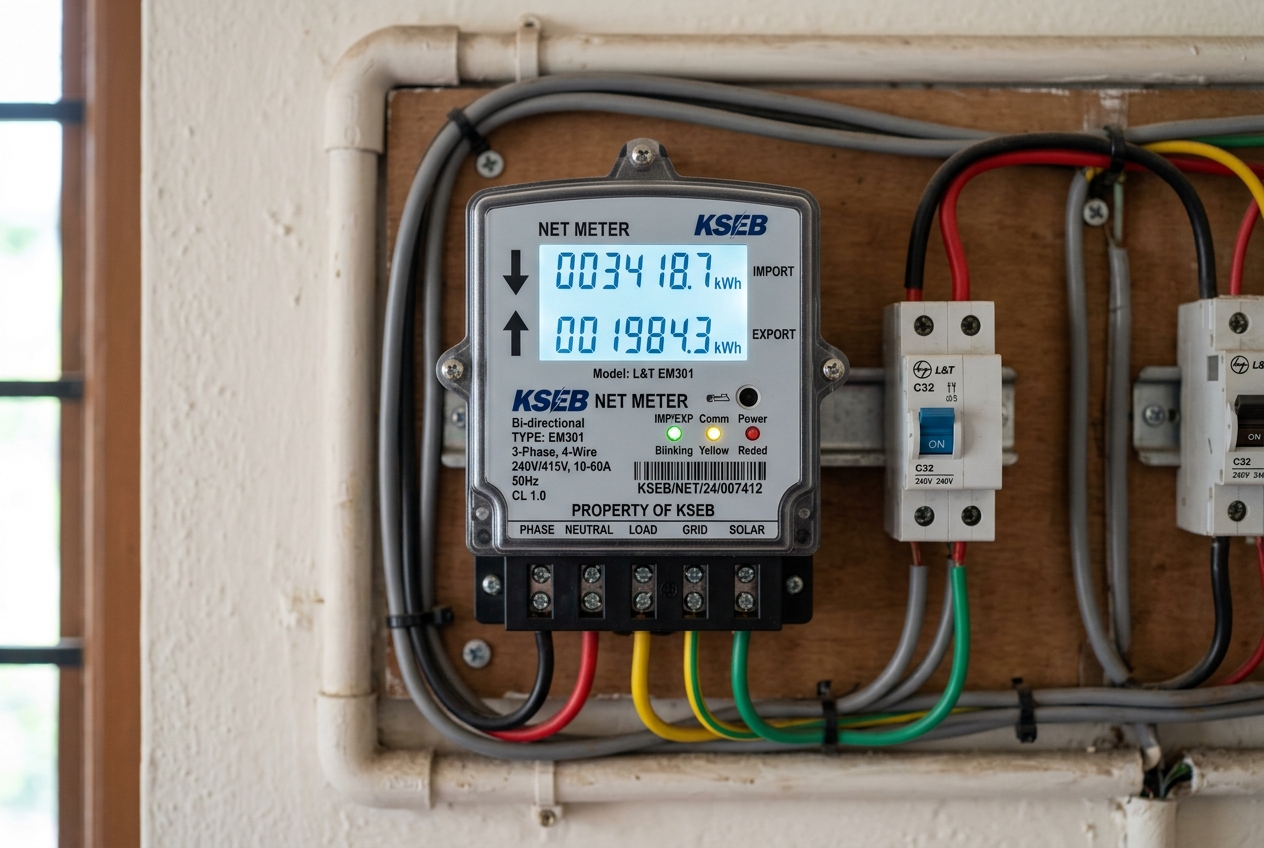
KSEB & Kerala Regulations
KSEB Solar Net Metering Explained: Bi-Directional Billing, Banking Rules & KSERC Tariff Settlement
Read
Solar Technology & Hardware