
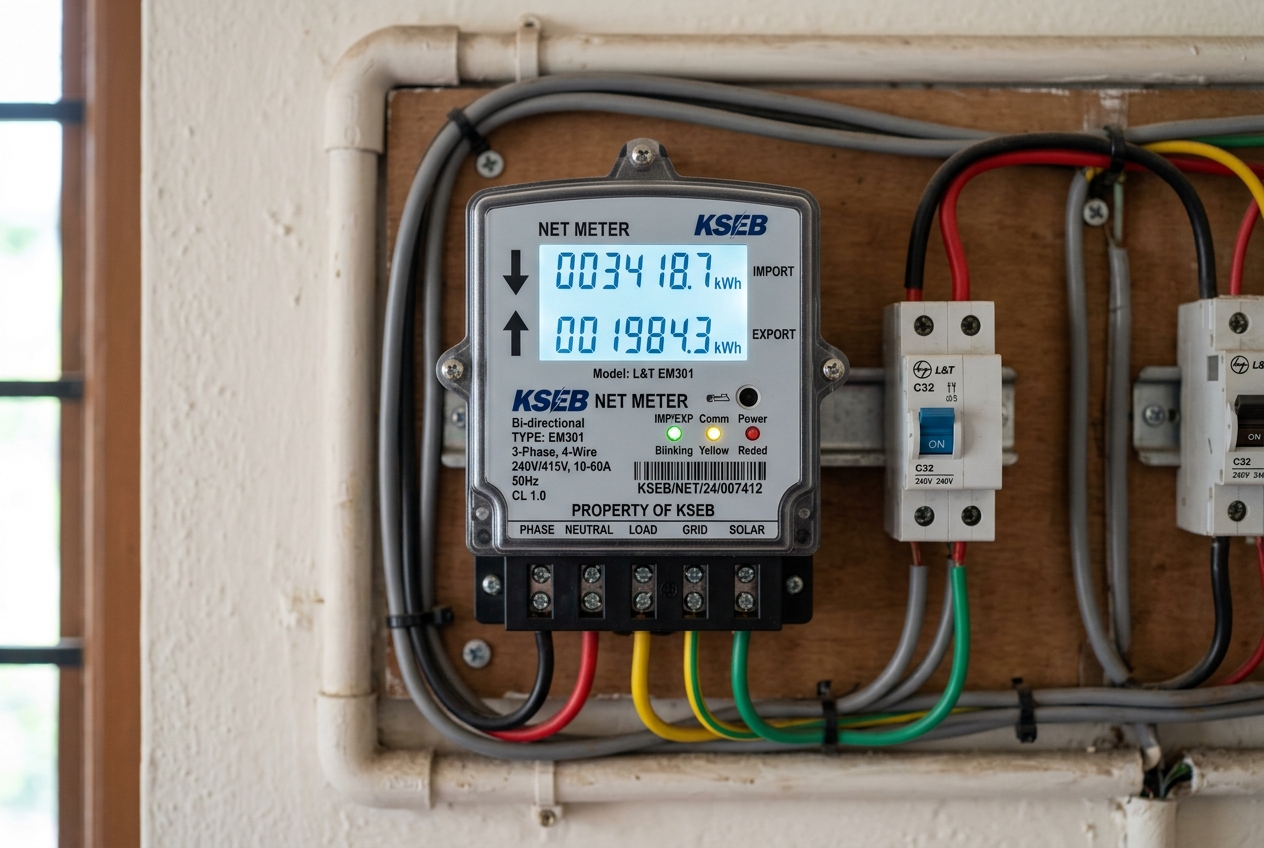
KSEB Solar Net Metering Explained: Bi-Directional Billing, Banking Rules & KSERC Tariff Settlement
Detailed analysis of how KSEB bi-directional net meters record export vs import, banking settlement cycles (October to September), surplus energy payment rates, and bi-monthly domestic tariff offsets.
Disclaimer: GSR Energies is an independent solar EPC contractor empaneled for PM Surya Ghar & KSEB net-metering installations. Government policies and subsidy guidelines are referenced directly from MNRE/KSEB official notifications.
- A bi-directional net meter replaces your existing single-directional energy meter to log imported units, exported units, and net energy balance.
- Solar energy generated during daylight hours first powers household appliances; excess surplus is exported into the KSEB 230V/415V distribution grid.
- The KSEB net metering settlement period runs annually from October 1 to September 30.
- Surplus banked units at the end of the settlement year are compensated by KSEB at the Commission-approved Average Power Purchase Cost (APPC).
- Net metering completely eliminates the higher penalty slabs of Kerala telescopic domestic electricity tariffs.
Table of Contents
How Bi-Directional Net Metering Operates in Practice
Net metering is an electricity billing mechanism that allows consumers who generate their own electricity from rooftop solar systems to feed excess electricity back into the KSEB grid. Unlike standard utility meters that register power flow only in one direction, a bi-directional meter records both forward flow (electricity drawn from KSEB) and reverse flow (electricity injected by your solar inverter).
When your rooftop solar array generates 4 kW during noon, and your home consumes 1.5 kW (refrigerators, fans, lights), the remaining 2.5 kW flows backward through the net meter into the KSEB grid, turning your energy counter backward in credit terms.
KSEB Annual Banking & Settlement Cycle (October to September)
Under KSERC regulations, the settlement period for net metering in Kerala runs from October 1 of a calendar year to September 30 of the following year. This annual window is specifically advantageous for Kerala climate conditions because it allows solar owners to bank substantial surplus units during sunny summer months (January to May) to offset cloudy monsoon periods (June to August).
If at the end of the settlement year (September 30), the consumer has net surplus exported units remaining in their account, KSEB compensates the consumer for these surplus units at the Commission-approved Average Power Purchase Cost (APPC rate, typically around ₹3.20 to ₹3.50 per unit).
| Billing Parameter | Normal Household (No Solar) | Solar Net-Metered Household (3 kW) |
|---|---|---|
| Bi-Monthly Units Drawn | 700 units | 700 units (Gross) |
| Bi-Monthly Solar Generation | 0 units | 750 units (Gross) |
| Net Units Billed by KSEB | 700 units | 0 units (Surplus 50 units banked) |
| Estimated KSEB Bi-Monthly Bill | ₹5,800 – ₹6,400 | ₹80 – ₹120 (Fixed meter charges only) |
| Annual Grid Bill Savings | Nil | ₹34,000 – ₹38,000 / year |
Crushing Kerala Telescopic Tariff Slabs
Kerala State Electricity Regulatory Commission structures domestic electricity billing on a progressive telescopic tariff. The first 50 units are priced modestly, but as usage exceeds 250 units, the tariff rises steeply. Net metering offsets energy starting from the highest, most expensive slab downward.
By suppressing net consumption below 100 or 0 units, a homeowner avoids paying peak unit rates, fuel surcharge adjustments, and high electricity duty percentages.
KSEB Meter Specifications & Laboratory Testing Protocols
The bi-directional meter installed must comply with CEA (Installation and Operation of Meters) Regulations and Indian Standard IS 13779 / IS 14697. It is either procured directly by the consumer through approved manufacturers or supplied by KSEB upon payment of testing fees.
Before field installation, the meter undergoes rigorous calibration and accuracy testing at an accredited KSEB Meter Testing Laboratory (TMR Division) to ensure zero metering deviation.
Kerala Rooftop Solar & KSEB Implementation Impact
How these regulations, technical specifications, and standards apply specifically to homes and commercial setups connected to the Kerala State Electricity Board (KSEBL) grid:
- Kerala residential customers on bi-monthly billing can carry forward daytime solar export credits to offset high nighttime AC and appliance consumption.
- Prevents households from crossing the high-cost 250+ units tariff thresholds where per-unit charges jump significantly.
- Provides peace of mind with 100% legal grid synchronization certified by KSEB sub-division electrical engineers.
Frequently Asked Questions
Does on-grid net metering supply electricity during a KSEB power blackout?
Standard on-grid inverters shut down during power outages for worker safety (anti-islanding). If backup power during grid cuts is required, a Hybrid Solar System with LiFePO4 battery storage must be installed.
Can my neighbor use my banked solar electricity?
No. Net metering credits are strictly mapped to your specific KSEB Consumer Number and connection service point.
Internal Solar Resources for Kerala
Explore Helpful Kerala Solar Tools & Guides
Kerala Solar Subsidy Calculator
Calculate system sizing, monthly savings & PM Surya Ghar subsidy
KSEB Net Metering Regulations
Full step-by-step application walkthrough for KSEBL bi-directional meters
Residential Rooftop Solar Solutions
On-grid, hybrid, and battery storage turnkey installation packages
Free Kerala Rooftop Site Assessment
Request shadow analysis & personalized engineering feasibility study
Free Solar Proposal For Your Roof
Planning Solar for Your Home or Business in Kerala?
Get an accurate rooftop survey, shadow analysis, and subsidy calculation — with zero charges and zero obligation.
Related Solar Guides & News

Central Schemes & Subsidies
PM Surya Ghar Muft Bijli Yojana in Kerala: 2026 Subsidy Structure, KSEB Feasibility & Application Guide
Read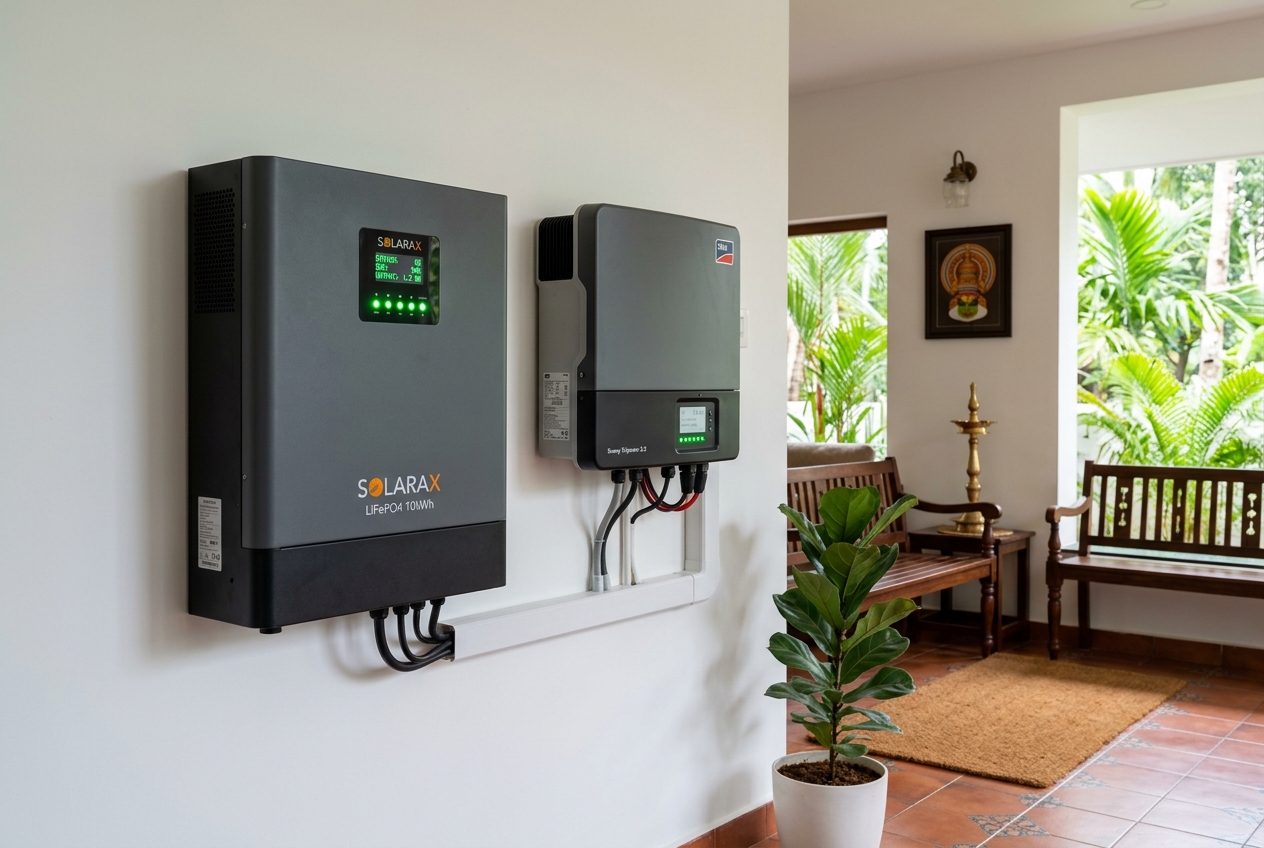
Solar Technology & Hardware
Hybrid Solar Systems with LiFePO4 Storage: Grid-Interactive Inverters & Power Outage Protection
Read
Sizing, Savings & ROI