
Bifacial Solar Panels in Kerala: Does Double-Sided Generation Work on Tiled & Flat Terraces?
A comprehensive technical analysis of dual-glass bifacial TOPCon modules for Kerala homes. How light reflection (albedo) from white mosaic and tiled terraces delivers 15%–25% extra generation, required structure elevation, and monsoon resistance.
Disclaimer: GSR Energies is an independent solar EPC contractor empaneled for PM Surya Ghar & KSEB net-metering installations. Government policies and subsidy guidelines are referenced directly from MNRE/KSEB official notifications.
- Bifacial solar modules generate clean electricity from both the front sun-facing side and the rear surface by capturing scattered ground reflection (albedo).
- In Kerala, installing bifacial panels over white heat-reflective roof paint or light ceramic tiles yields 15% to 22% additional units compared to monofacial panels.
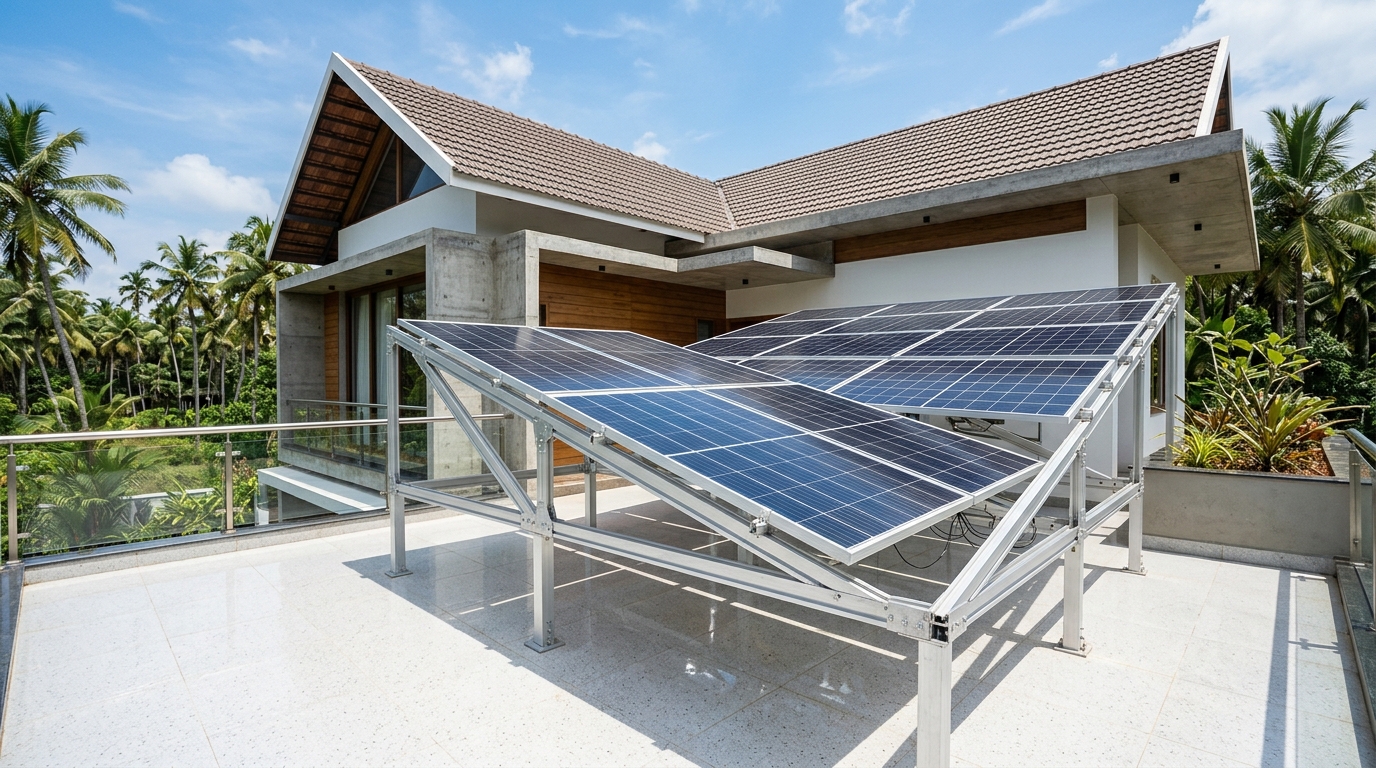
- To maximize backside yield, arrays must be elevated at least 1.0 to 1.5 meters above the terrace surface to allow scattered light to reach underneath.
- Dual-glass (glass-to-glass) construction completely eliminates traditional plastic backsheet degradation, making them impervious to Kerala high monsoon humidity and salt-laden coastal winds.
- Bifacial TOPCon modules have a lower temperature coefficient (-0.30%/°C), maintaining higher efficiency during sweltering 36°C+ Kerala summer afternoons.
Table of Contents
How Bifacial Generation Works in Tropical Latitudes
Conventional monofacial solar modules absorb sunlight solely from their front glass surface. The rear of the panel is covered by an opaque white or black polymer Tedlar backsheet that blocks all light.
Bifacial solar panels replace this opaque backsheet with high-transparency tempered glass. Active TOPCon n-type silicon cells inside are engineered with symmetrical front and rear grid fingers. When direct sunlight hits the front, power is produced normally. Simultaneously, ambient diffuse sunlight bouncing off the terrace floor, parapet walls, and surrounding cloud cover hits the underside of the panel, generating continuous secondary current.
This secondary energy gain is known as the "bifacial bifaciality factor", which in modern n-type TOPCon modules ranges from 80% to 85% of front-side efficiency.
The Role of Terrace Albedo in Kerala Homes
Albedo refers to the reflectivity of the surface beneath the solar panels. In Kerala, typical terrace surfaces exhibit varying albedo coefficients that directly dictate the backside generation bonus.
Applying a white weather-coat reflective cooling paint or laying light-colored exterior terrace tiles drastically enhances backside generation, turning your flat roof into an active reflective optical basin.
| Terrace Surface Type | Albedo Reflectivity (%) | Expected Bifacial Gain (%) |
|---|---|---|
| Standard Grey Concrete (unpainted) | 18% – 22% | 8% – 11% Extra Units |
| Kerala Red Terracotta Roof Tiles | 20% – 25% | 10% – 13% Extra Units |
| Light Cream / Ivory Ceramic Tiles | 45% – 55% | 16% – 20% Extra Units |
| Ultra-White Solar Reflective Cooling Paint | 70% – 80% | 20% – 25% Extra Units |
Mounting Height & Structural Engineering Requirements
A common mistake in domestic solar installations is mounting bifacial panels flush or too close to the floor (e.g. 30 cm). Without sufficient clearance, sunlight cannot bounce underneath, resulting in almost zero bifacial gain.
At GSR Energies, our engineering team standardizes custom hot-dip galvanized elevated structures that elevate the bottom edge of the array 1.2 to 1.5 meters above the terrace. This not only allows ample diffuse light reflection from all angles, but also keeps the terrace 100% usable as a shaded living space for washing machines, clotheslines, and rooftop leisure.
Dual-Glass Architecture: Why It Outlasts Monsoon Conditions
In tropical coastal states like Kerala, high relative humidity (often exceeding 85% during monsoon season) combined with airborne salinity poses a long-term threat to traditional polymer backsheets. Over 10–12 years, backsheets can yellow, crack, or suffer from moisture ingress that leads to Potential Induced Degradation (PID) and ground faults.
Bifacial panels feature dual 2.0 mm tempered glass sheets encapsulating the cells front and back. Glass is completely chemically inert, zero-permeability to moisture, and highly scratch-resistant. This dual-glass sandwich provides fire class A rating and allows manufacturers to offer 30-year linear performance warranties with degradation rates as low as 0.4% per year.
Kerala Rooftop Solar & KSEB Implementation Impact
How these regulations, technical specifications, and standards apply specifically to homes and commercial setups connected to the Kerala State Electricity Board (KSEBL) grid:
- Allows Kerala homes with limited terrace area (such as 250–350 sq.ft) to generate the electricity output of a system 20% larger.
- Dual-glass modules withstand gale-force monsoon winds up to 160 km/h with zero cell micro-cracking risk.
- Reduces the levelized cost of energy (LCOE) to below ₹1.95 per unit over the 30-year design lifespan.
Frequently Asked Questions
Are bifacial solar panels covered under PM Surya Ghar DBT subsidy?
Yes. As long as the bifacial modules utilize Indian-manufactured DCR (Domestic Content Requirement) solar cells and are listed on the MNRE ALMM portal, they are fully eligible for the maximum ₹78,000 subsidy in Kerala.
Will bifacial panels produce power during cloudy monsoon days?
Yes, often better than monofacial panels! Cloudy and overcast skies create high diffuse radiation. Bifacial panels capture diffuse ambient light from all 360-degree angles, sustaining modest but reliable daily generation even without harsh direct sun.
Does an elevated bifacial structure require extra municipal permissions in Kerala?
Standard rooftop solar structures under Kerala Building Rules (KBR) are treated as non-habitable rooftop equipment. When designed within approved height limits and wind load specifications (up to 160 km/h), no separate building permit is required.
Internal Solar Resources for Kerala
Explore Helpful Kerala Solar Tools & Guides
Kerala Solar Subsidy Calculator
Calculate system sizing, monthly savings & PM Surya Ghar subsidy
KSEB Net Metering Regulations
Full step-by-step application walkthrough for KSEBL bi-directional meters
Residential Rooftop Solar Solutions
On-grid, hybrid, and battery storage turnkey installation packages
Free Kerala Rooftop Site Assessment
Request shadow analysis & personalized engineering feasibility study
Free Solar Proposal For Your Roof
Planning Solar for Your Home or Business in Kerala?
Get an accurate rooftop survey, shadow analysis, and subsidy calculation — with zero charges and zero obligation.
Related Solar Guides & News
Solar Technology & Hardware
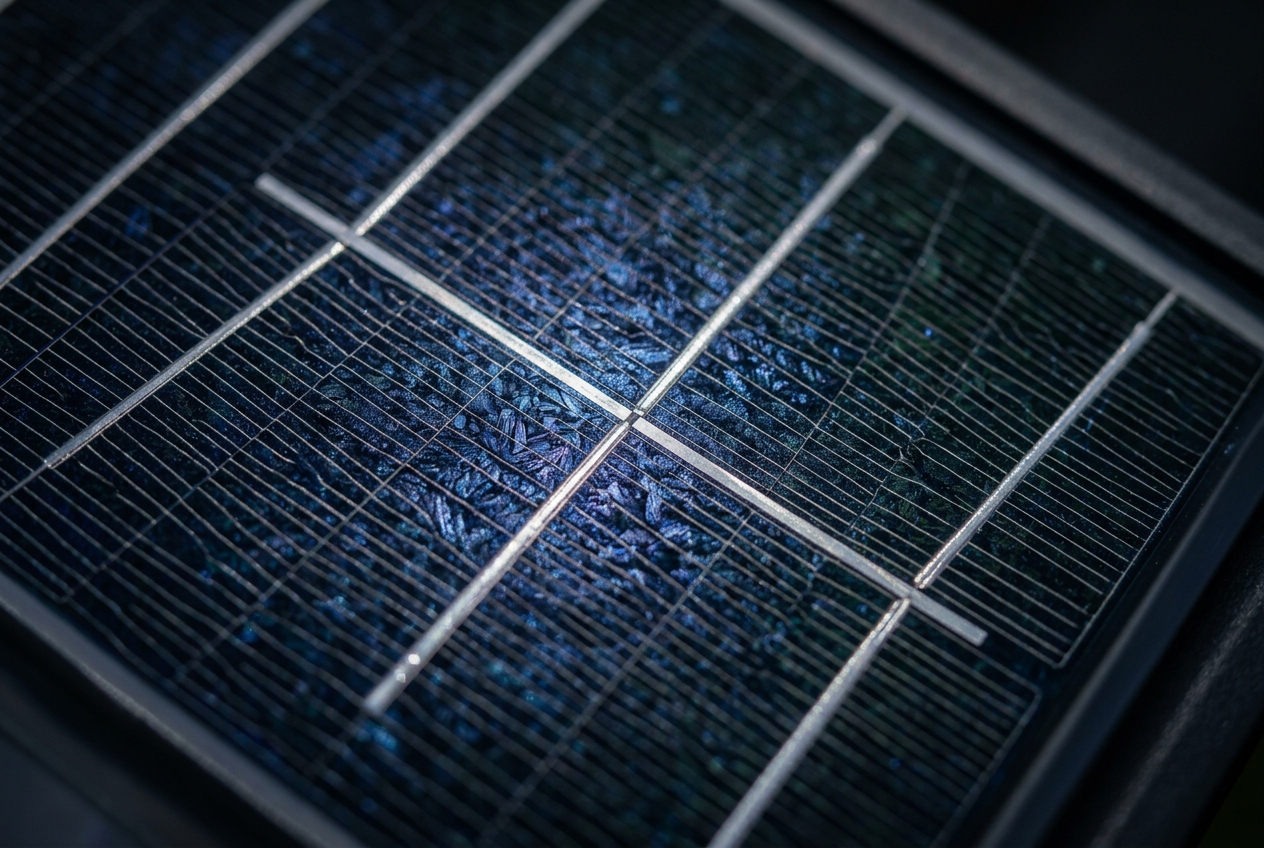
N-Type TOPCon vs Mono PERC in Kerala: Generation Efficiency, Monsoon Performance & Heat Degradation
Read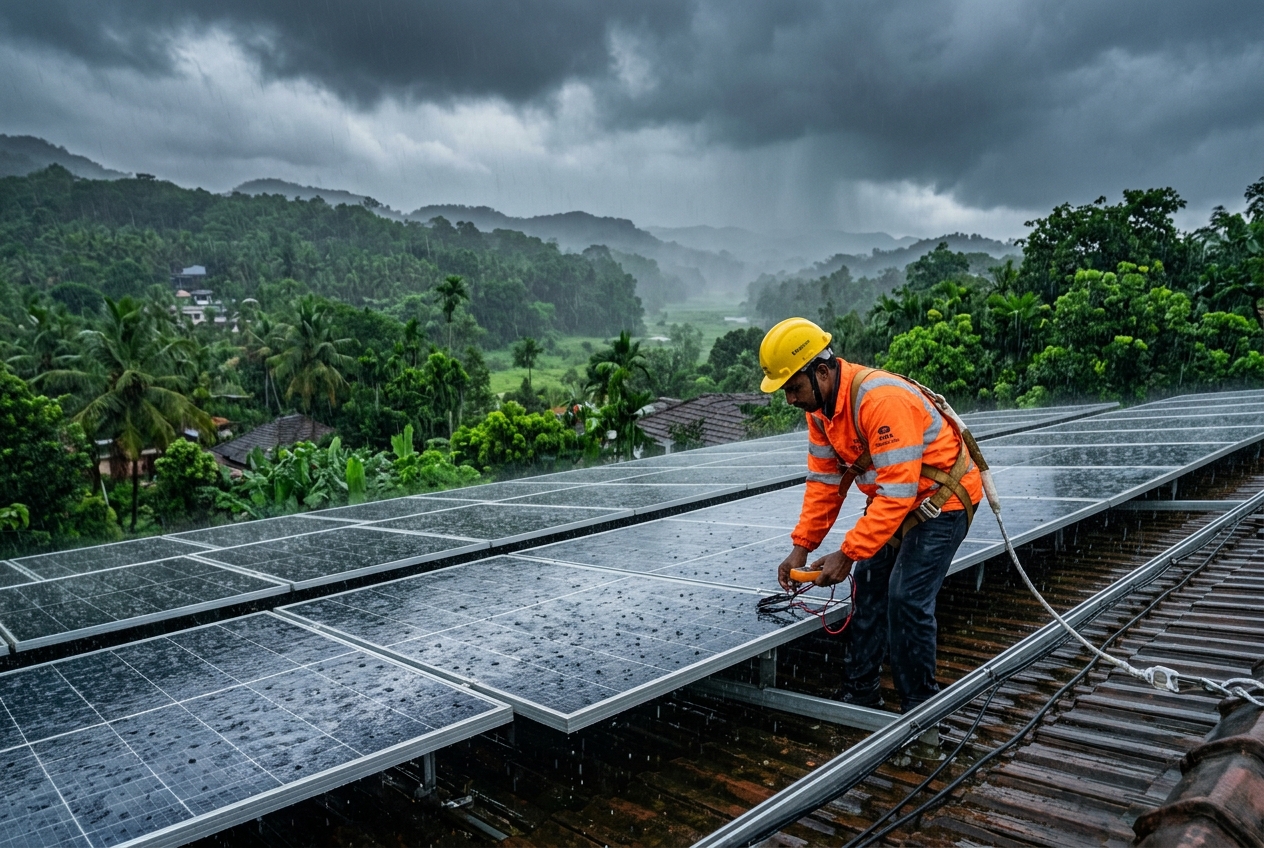
Maintenance & Performance
Kerala Monsoon Solar Maintenance: Plant Generation in Heavy Rain, Algae Prevention & Lightning Protection
Read
Sizing, Savings & ROI